Government Introduces Unified National Identity Card with QR-Based Verification
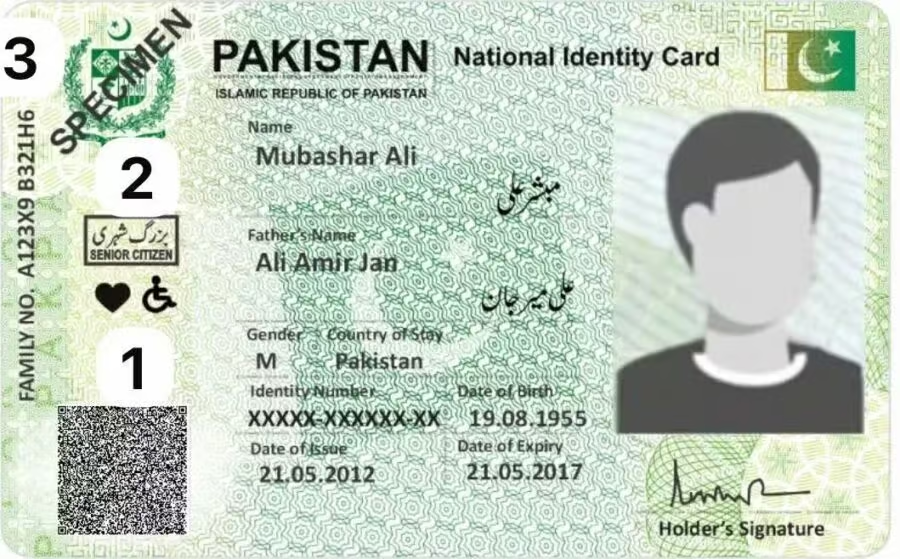
The federal government has officially announced major upgrades to Pakistan’s identity management system, introducing a single, uniform National Identity Card (NIC) that will replace the previously parallel chip-enabled and non-chip card formats.
The reforms, introduced under the government’s “One Nation – One Identity” vision, also upgrade the Pakistan Origin Card (POC) framework. The amendments were issued through S.R.O. 330(I)/2026 and S.R.O. 331(I)/2026, and were published in the official Gazette on February 24, 2026.
QR Code Introduced as Legal Authentication Feature
A key feature of the amendments is the formal legal recognition of the Quick Response (QR) code as a security and authentication mechanism across identity documents. Under the revised rules, the QR code is defined as a secure, machine-readable, two-dimensional barcode that contains encoded identity data and enables instant verification when scanned.
The amendments also authorize National Database and Registration Authority (NADRA) to deploy “QR code or any other technological feature,” allowing the national identity system to adapt to future innovations without requiring repeated legal revisions.
Officials said the QR-based architecture strengthens Pakistan’s digital identity ecosystem and supports integration with national data platforms, enabling both online and offline verification, faster service delivery, reduced manual checks, and lower risks of fraud and impersonation.
Stronger Fraud Controls and Biometric Security
The updated rules introduce tighter fraud prevention measures. Once an identity card is suspended, all related verification and authentication services will be automatically blocked, preventing misuse across digital platforms and institutional systems.
Biometric security has also been enhanced, with fingerprints and iris scans now explicitly recognized as official authentication modalities. This marks a shift toward multi-modal biometric verification, further strengthening identity security.
Lifetime ID Cards for Senior Citizens
In a major facilitation step, citizens aged 60 years and above—both residents and overseas Pakistanis—will now be issued lifetime-validity identity cards featuring a distinct senior citizen logo. The move eliminates the need for repeated renewals and reflects a more citizen-centric approach for elderly individuals.
Standardized IDs for AJK Residents
The amendments also introduce standardized identification for individuals belonging to Azad Jammu and Kashmir, requiring identity cards to carry a specific inscription clearly defining their residency status.
Updated Formats Across All ID Categories
To complete the modernization process, the government has revised the specimen formats for all major identity documents. These include cards for resident citizens, overseas Pakistanis, persons with disabilities, child registration certificates, organ donors, combined categories, and AJK residents. The new formats unify the design structure and embed QR-based security as a core feature.
Strengthening Digital Governance
Overall, the 2026 amendments significantly reinforce the backbone of Pakistan’s national identity system. By enhancing digital trust, improving fraud prevention, enabling real-time verification, and introducing meaningful facilitation measures, the reforms position Pakistan for the next phase of digital governance.
Officials said the upgraded identity framework will support a more secure, interoperable, and future-ready digital ecosystem, ensuring that citizen services evolve in line with global best practices.